Astronomer’s Telegram:
Title: Coincident gamma-ray
emission in the direction of the active repeater FRB20240114A
Authors: Yi Xing, Wenfei Yu
(Shanghai Astronomical Observatory)
Contact e-mail: wenfei@shao.ac.cn
Following the recent reports
of the discovery of the repeating FRB 20240114A (ATel #16420) and its extreme radio burst activity (bright bursts - ATel #16432; burst storm -
Atel #16505; more than a hundred bright bursts - Atel #16565), we performed a
search for gamma-ray emission potentially associated with the central engine
activities and the bursting activities of
the repeater with Fermi LAT at the precise position reported
by the recent burst localization with the EVN (Atel #16542), which followed the
MeerKAT's initial burst localization to the
1.5 arcsec level (Atel #16446).
We performed an aperture photometry analysis of the public Fermi LAT data. In the 5-day averaged LAT
light curves extracted from photons (> 100 MeV) in a sky region centered at
the source with the contaminant angle of the LAT point spread function
(circular regions with a typical radius of 5.3
degrees or less, depending on photon energies), we found two episodes of
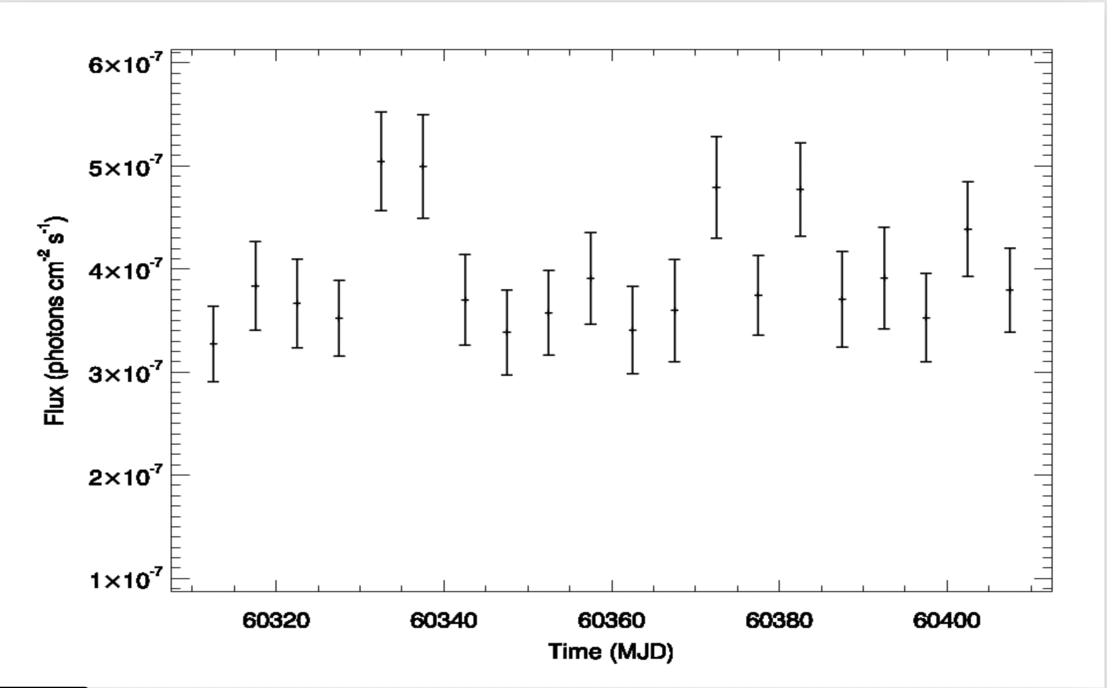
enhanced gamma-ray emission in the direction of the FRB source during MJD 60330 - 60340 (2024 Jan 21 - Jan 30) and
MJD 60370 - 60385 (2024 March 1 - March 15), which are coincident with the enhanced bursting activities (Atel #16420, 16430, 16433) and the
hyper-active burst storms (burst rate
increased to ~ 500 per hour, Atel #16505). The 5-day averaged gamma-ray flux
level derived
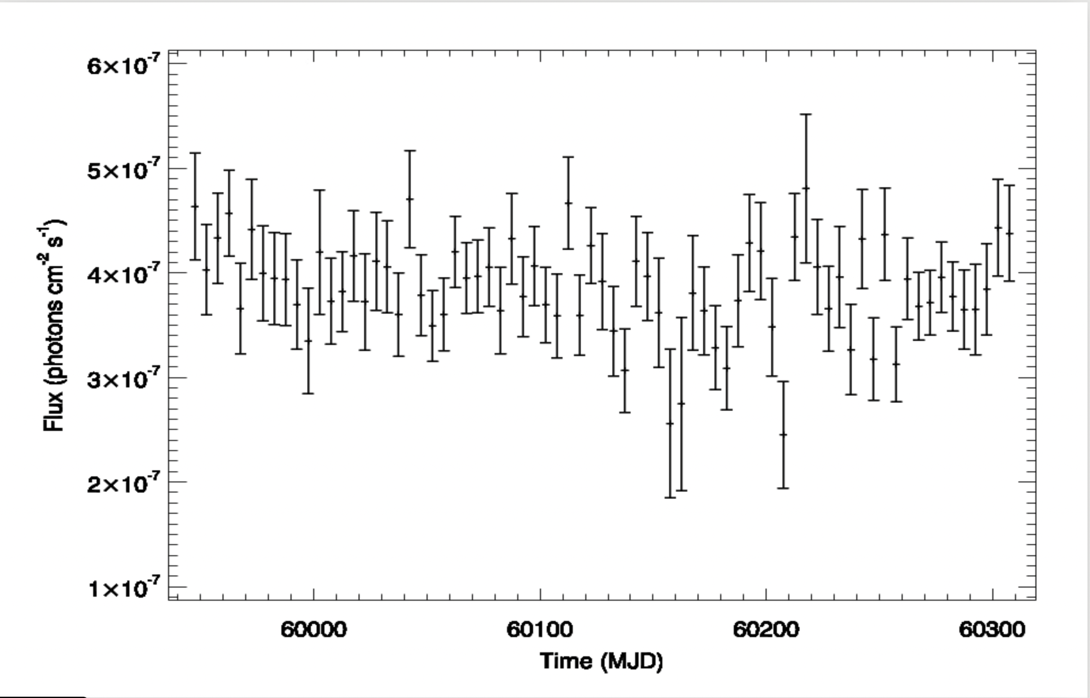
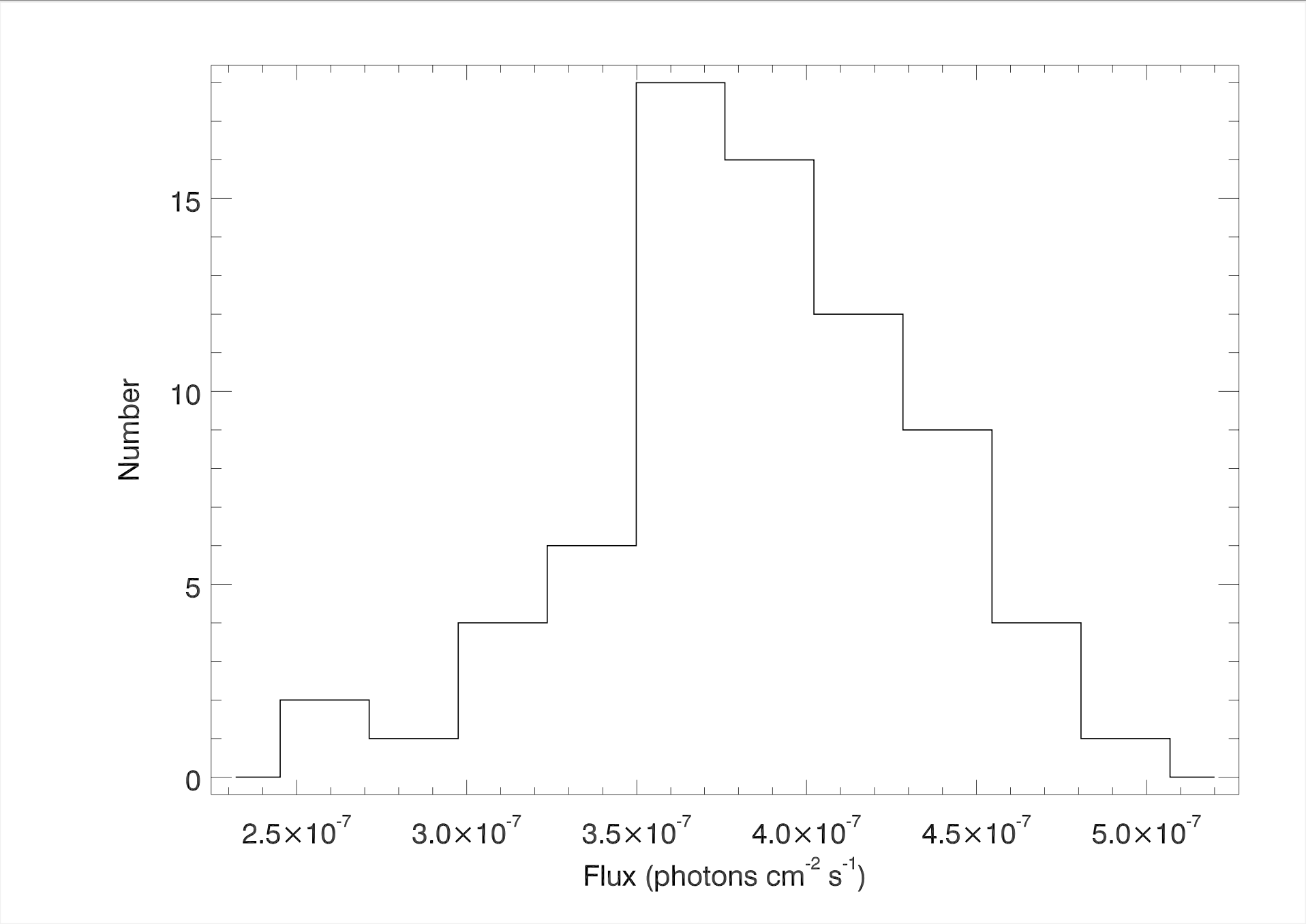
by the aperture photometry analysis during the first episode (a 10 day window) had never been reached in the previous year as seen in the Fermi LAT light curve, suggesting a chance
possibility of about 0.02% for the occurrence of the
first episode alone.
There are known Fermi catalog sources nearby: one source within 1
degree, two other sources within 2 degrees, and even six other sources 4-5
degrees away. Based on a customized selection of photons in the two time windows, we further obtained an estimate of the
position of the potential variable source responsible for the flux
variation, which is in favor of an association with FRB 20240114A rather
than an
association with those nearby sources. We
also noticed that only a few
GeV photons have been detected by Fermi/LAT in the data we analyzed. We encourage further multi-wavelength monitoring of
the source and the search for similar signatures of variations on these time scales in addition to radio burst detections.
The Fermi LAT light curves are shown here below.
We thank the Fermi Science
Support Center (FSSC) for providing public data timely. The Fermi LAT is a pair
conversion telescope designed to cover the energy band from 20 MeV to greater
than 300 GeV. It is the product of an international collaboration between NASA
and DOE in the U.S. and many scientific institutions across France, Italy,
Japan and Sweden.
Plots of 5-day averaged Fermi LAT light curves and statistics:
1.
The 2024 Fermi LAT light curve (5 day averaged)
2.
The 2023 Fermi LAT light curve (5 day averaged)
3.
The histogram of the 5-day averaged flux bins
4.
Reference: About Fermi LAT model-independent aperture photometry analysis - here is the Fermi SSC official note (https://fermi.gsfc.nasa.gov/ssc/data/analysis/scitools/aperture_photometry.html).